Why Restaurants Face $800,000+ Labor Compliance Penalties
The Hidden Cost of Non-Compliance
Labor compliance violations are reaching crisis levels in the restaurant industry. Department of Labor audit activity increased 11% in 2024, with restaurants identified as priority targets for "low-wage, high violation" enforcement. Recent penalties paint a sobering picture of the financial exposure.
Recent Enforcement Actions
- **McMenamins**: Paid $800,000 for improperly distributed tips over three years
- **Pizzicato**: Settled for $570,000 to 367 workers (DOL initially demanded $2 million)
- **Minneapolis Pizza Restaurant**: $105,784 total ($44,915 back wages, $44,915 liquidated damages, $15,954 civil penalties)
- **California Restaurant**: $140,000 in back wages and damages plus $5,000 in federal penalties to 35 employees
The Most Common Violations
Tip Pooling Errors
Federal penalties reach $1,162 per violation for tip pooling infractions, while the IRS can assess penalties of 50% of owed Social Security and Medicare taxes for unreported tips. Industry data shows 90% of all employee inquiries relate to tips, consuming significant management bandwidth.
Predictive Scheduling Violations
Eight major cities now enforce predictive scheduling laws with penalties ranging from $300 to $1,000 per violation. Berkeley's January 2024 law exemplifies the enforcement intensity: $1,000 per affected employee plus $500 per violation plus $50 reimbursement per employee.
Overtime Miscalculations
Complex tip credit rules and split shifts make overtime calculations error-prone. Seven states prohibit tip credits entirely, while 16 states use the federal baseline of $2.13 hourly, creating a compliance maze for multi-state operators.
Why Traditional Systems Fail
Only 36% of restaurants consistently hit their labor cost targets, with 38% of shifts improperly staffed in any given week according to Crunchtime's 2023 Restaurant Operations Report. Most scheduling systems weren't built with compliance in mind, treating it as an afterthought.
The Manager's Dilemma
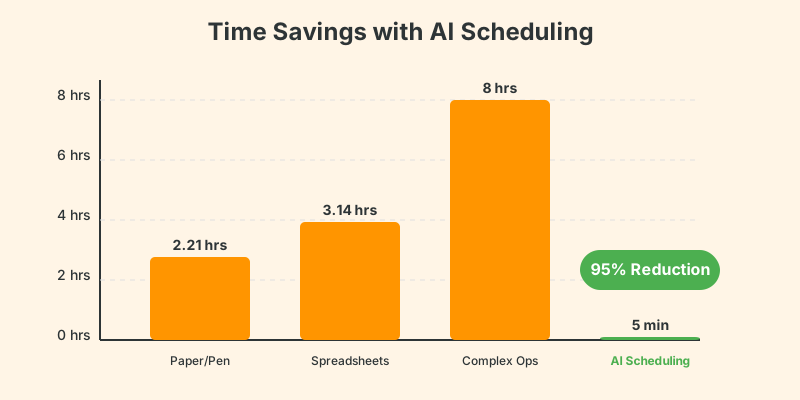
Restaurant managers dedicate 6.61% of their total work week (137 hours annually) to employee scheduling tasks. They're juggling customer complaints, inventory, training, and trying to keep labor costs under control. Compliance often falls through the cracks not from negligence, but from overwhelm.
The Real Cost of Violations
Major chains face catastrophic penalties ranging from $469,000 to $4 million for systemic violations. Beyond immediate fines, compliance violations carry hidden costs:
- **Legal fees** for defending against claims
- **Back wages** with interest and penalties
- **Increased insurance premiums**
- **Reputation damage** from public violations
- **Employee turnover** from compliance-related disputes
Ready to Transform Your Restaurant Operations?
Join The Founding Shift and be among the first 50 restaurants to shape the future of restaurant management.
How AI Changes the Game
Modern AI-powered scheduling platforms can prevent violations before they happen by:
1. Automated Compliance Checking
Every schedule change is instantly validated against federal, state, and local labor laws. The system knows your location's specific requirements and applies them automatically.
2. Real-Time Alerts
Managers get notified before making scheduling decisions that could lead to violations. Trying to schedule a minor past 10 PM on a school night? The system stops you before you publish.
3. Smart Documentation
Automated record-keeping that captures everything needed for compliance audits. Time stamps, break acknowledgments, and schedule changes are all documented without manual entry.
4. Predictive Analysis
AI can identify patterns that lead to violations before they become habits. Maybe your Tuesday dinner rush consistently causes missed breaks—the system will flag this and suggest solutions.
Taking Action
The first step is understanding where you're vulnerable. A compliance audit of your current practices can reveal gaps you didn't know existed. From there, implementing the right technology and training can transform compliance from a burden into a competitive advantage.
Remember: Every dollar spent on compliance prevention saves $3-5 in potential violations, legal fees, and operational disruptions.
The Path Forward
Labor compliance doesn't have to be complicated. With the right systems in place, you can focus on what matters most—delivering great experiences to your customers while taking care of your team.
The restaurants that thrive in the next decade will be those that embrace technology not as a replacement for good management, but as a tool that makes good management possible at scale.
Sarah Chen
Former restaurant operations director with 15 years of experience, now helping restaurants modernize their operations.
Join The Founding Shift
Get lifetime founding rates and help shape the future of restaurant operations.
Related Articles
AI Scheduling Saves 137 Hours Annually Per Manager
Restaurant managers waste 2.64 hours weekly on manual scheduling. See how automation reduces time by 95% while preventing compliance violations.

Predictive Scheduling Laws: $1,000 Per Violation Risk
Eight major cities now enforce predictive scheduling laws with penalties up to $1,000 per violation. Navigate the complex compliance landscape.