
Predictive Scheduling Laws: $1,000 Per Violation Risk
The Regulatory Landscape
Eight major cities now enforce predictive scheduling laws with penalties ranging from $300 to $1,000 per violation, creating complex compliance challenges for multi-location operators. Oregon remains the only state with comprehensive legislation.
Where Laws Are Active with Specific Penalties
- **Berkeley (Jan 2024)**: $1,000 per affected employee + $500 per violation + $50 reimbursement per employee
- **New York City**: $300 first violation, $500 for subsequent (fast food specific)
- **Seattle**: 14-day notice for retail/food service (500+ employees globally)
- **Chicago**: Predictability pay for changes within 14 days (100+ employees or chains with 250+ employees and 30 locations)
- **Oregon**: 14-day advance notice with 1-hour pay penalties for changes (500+ employees)
- **San Francisco**: 2-week notice for formula retail including chain restaurants
- **Los Angeles**: Various requirements for retail including restaurants
- **Philadelphia**: 14-day notice for retail/food service
Key Requirements and Penalties
Advanced Notice Requirements
Oregon leads with 14-day advance notice requirements, with penalties of 1-hour pay for changes. Berkeley's January 2024 law exemplifies enforcement intensity with triple-layer penalties.
State-Level Prohibition
Ten states actively prohibit local predictive scheduling laws:
- Alabama, Arkansas, Florida, Georgia, Indiana
- Iowa, Kansas, Michigan, Ohio, Tennessee
This creates a patchwork where multi-state operators must navigate different requirements by municipality.
Compliance Costs
The National Restaurant Association reports compliance costs average 10% of total income for complex multi-jurisdictional operations, including:
- Legal consultation
- System modifications
- Ongoing training
- Audit preparation
Ready to Transform Your Restaurant Operations?
Join The Founding Shift and be among the first 50 restaurants to shape the future of restaurant management.
Robert Kim
Contributing to ShiftRoll's mission of transforming restaurant operations through AI-powered innovation.
Join The Founding Shift
Get lifetime founding rates and help shape the future of restaurant operations.
Related Articles

Why Restaurants Face $800,000+ Labor Compliance Penalties
Department of Labor enforcement increased 11% in 2024, with restaurants as priority targets. Learn the most common violations and how to avoid catastrophic fines.
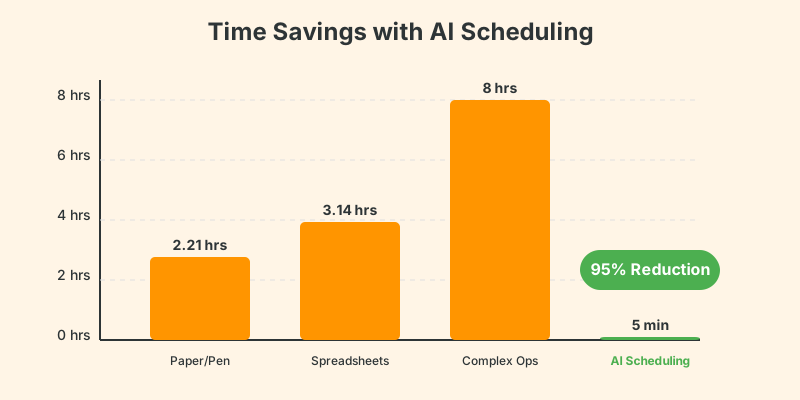
AI Scheduling Saves 137 Hours Annually Per Manager
Restaurant managers waste 2.64 hours weekly on manual scheduling. See how automation reduces time by 95% while preventing compliance violations.